Multi-Pathogen/Multi-Host Models
Here, we consider two concerns of epidemiology: multiple diseases or strains spreading through one host species and single disease that can be transmitted between different host species.
1. Simple SIR model with two strains
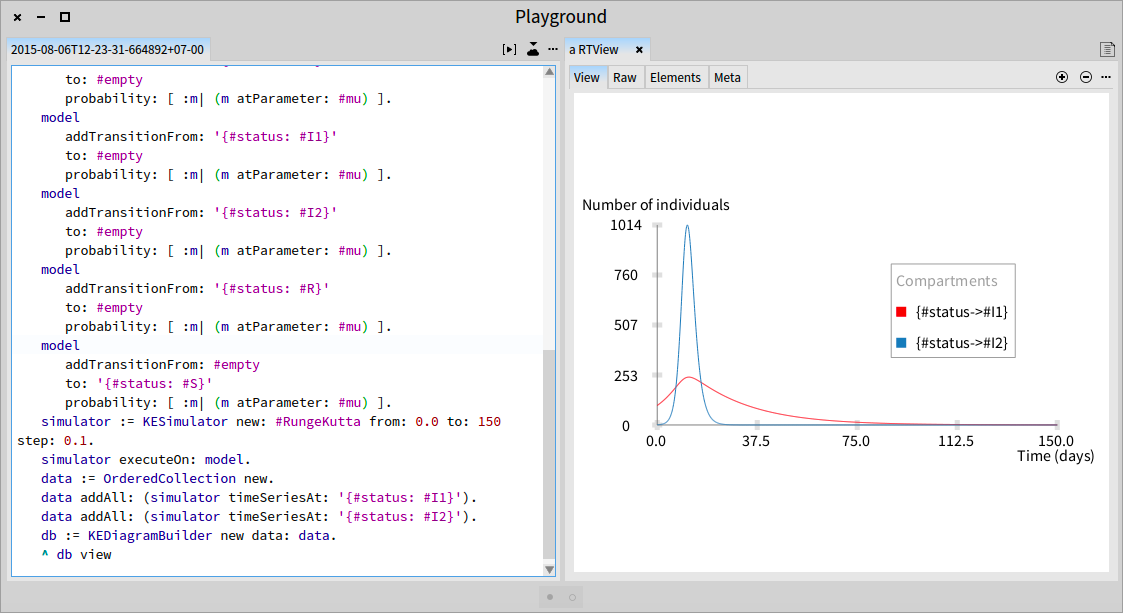
We deal with two co-circulating strains within a simplified SIR framework. These two strains are transmitted in the same population of susceptible. The system of equations represents this model is following:
|model simulator db data|
    model := KEModel new.
    model population attributes: {#status->#(#S #I1 #I2 #R)}.
    model buildFromCompartments: '{
        { #status: #S }: 9900,
        { #status: #I1 }: 99,
        { #status: #I2 }: 1,
        { #status: #R }: 0
    }'.
    model addParameter: #beta1 value: 0.00002.
    model addParameter: #beta2 value: 0.00018.
    model addParameter: #gamma1 value: 0.1.
    model addParameter: #gamma2 value: 1.
    model addParameter: #mu value: 5e-5.

    model
        addTransitionFrom: '{#status:#S}'
        to: '{#status: #I1}'
        probability: [ :m| (m atParameter: #beta1) * (m probabilityOfContact: '{#status:#I1}') ].
    model
        addTransitionFrom: '{#status:#S}'
        to: '{#status:#I2}'
        probability: [ :m| (m atParameter: #beta2) * (m probabilityOfContact: '{#status: #I2}') ].
    model
        addTransitionFrom: '{#status: #I1}'
        to: '{#status: #R}'
        probability: [ :m| (m atParameter: #gamma1) ].
    model
        addTransitionFrom: '{#status: #I2}'
        to: '{#status: #R}'
        probability: [ :m| (m atParameter: #gamma2) ].
    model
        addTransitionFrom: '{#status: #S}'
        to: #empty
        probability: [ :m| (m atParameter: #mu) ].
    model
        addTransitionFrom: '{#status: #I1}'
        to: #empty
        probability: [ :m| (m atParameter: #mu) ].
    model
        addTransitionFrom: '{#status: #I2}'
        to: #empty
        probability: [ :m| (m atParameter: #mu) ].
    model
        addTransitionFrom: '{#status: #R}'
        to: #empty
        probability: [ :m| (m atParameter: #mu) ].
    model
        addTransitionFrom: #empty
        to: '{#status: #S}'
        probability: [ :m| (m atParameter: #mu) ].

    simulator := KESimulator new: #RungeKutta from: 0.0 to: 150 step: 0.1.
    simulator executeOn: model.
    data := OrderedCollection new.
    data addAll: (simulator timeSeriesAt: '{#status: #I1}').
    data addAll: (simulator timeSeriesAt: '{#status: #I2}').
    db := KEDiagramBuilder new data: data.
    db view
2. SIR model with three species of hosts
In the standard models of epidemiology, the population is compartmentalized by only clinic status. As such, the population has only one degree of subdivision. In a context of multi-host (multi-species) model, the host population has two degrees of subdivision due to the attribute species of each individual.
2.1. Equations
2.2. Configurations of Kendrick model
In epidemiology, it is important to distinguish between two basic assumptions in terms of the underlying structure of contacts within the population. Either the model is assumed to be mass action or pseudo mass action. The first kind reflects the situation where the number of contacts is independent of the population size. So that the force of infection . In some circumstances, the transmission rate is rescaled by . The second one assumes that as the population size increases, so does the contact rate. As such the force of infection .
At the moment, Kendrick model includes three parameters of configuration: sizeOfPopulation, rescale, mass_action. By default:
#sizeOfPopulation->#population
#rescale->true
#mass_action->true
In the context of the multi-species model, it is important to config the size of population for each species. As such:
model configurations: {#sizeOfPopulation->#(#species)}
2.3. Kendrick model
In this model, we define the parameter for three scopes corresponding to each species. In order to represent the interaction between three species, we define a contact network. Due to this network, the force of infection will be modified as:
where denotes the strength of connection between species and .
| model graph |
    model := KEModel new.
    model
        population:
            (KEMetaPopulation new
                attributes:
                    {(#status -> #(#S #I #R)).
                    (#species -> #(#mosquito #reservoir1 #reservoir2))}).
    model
        buildFromAttributes: #(#status #species)
        compartments:
            {(#(#S #mosquito) -> 9800).
            (#(#I #mosquito) -> 200).
            (#(#R #mosquito) -> 0).
            (#(#S #reservoir1) -> 1000).
            (#(#I #reservoir1) -> 0).
            (#(#R #reservoir1) -> 0).
            (#(#S #reservoir2) -> 2000).
            (#(#I #reservoir2) -> 0).
            (#(#R #reservoir2) -> 0)}.
    model addParameter: #mu
           inScopes: {
                #species->#mosquito.
                #species->#reservoir1.
                #species->#reservoir2}
           values: #(12.17 0.05 0.05).
    model addParameter: #gamma value: 52.
    model addParameter: #beta value: 1.
    model addParameter: #N value: #sizeOfPopulation.
    model configurations: { #sizeOfPopulation->#(#species) }.

    graph := KEContactNetwork
            newOn: model population
            atAttribute: #species.
    graph edges: { #mosquito->#reservoir1. #mosquito->#reservoir2 };
            strengthOfAllConnections: 0.02.
    model
        addTransitionFrom: '{#status: #S}'
        to: '{#status: #I}'
        probability: [ :m | (m atParameter: #beta) * (m probabilityOfContact: '{#status: #I}') ].
    model
        addTransitionFrom: '{#status: #I}'
        to: '{#status: #R}'
        probability: [ :m | m atParameter: #gamma ].
    model
        addTransitionFrom: '{#status: #S}'
        to: #empty
        probability: [ :m | m atParameter: #mu ].
    model
        addTransitionFrom: '{#status: #I}'
        to: #empty
        probability: [ :m | m atParameter: #mu ].
    model
        addTransitionFrom: '{#status: #R}'
        to: #empty
        probability: [ :m | m atParameter: #mu ].
    model
        addTransitionFrom: #empty
        to: '{#status: #S}'
        probability: [ :m | m atParameter: #mu ].
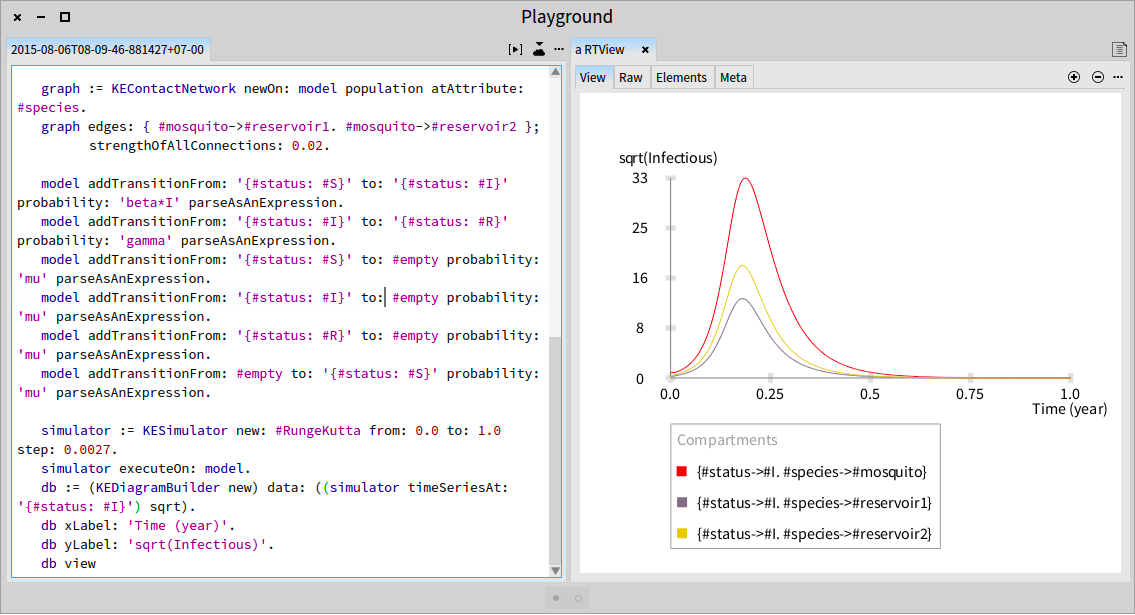
Stochastic dynamics of three hosts species using Gillespie's direct
Stochastic dynamics of three hosts species using agent-based approach